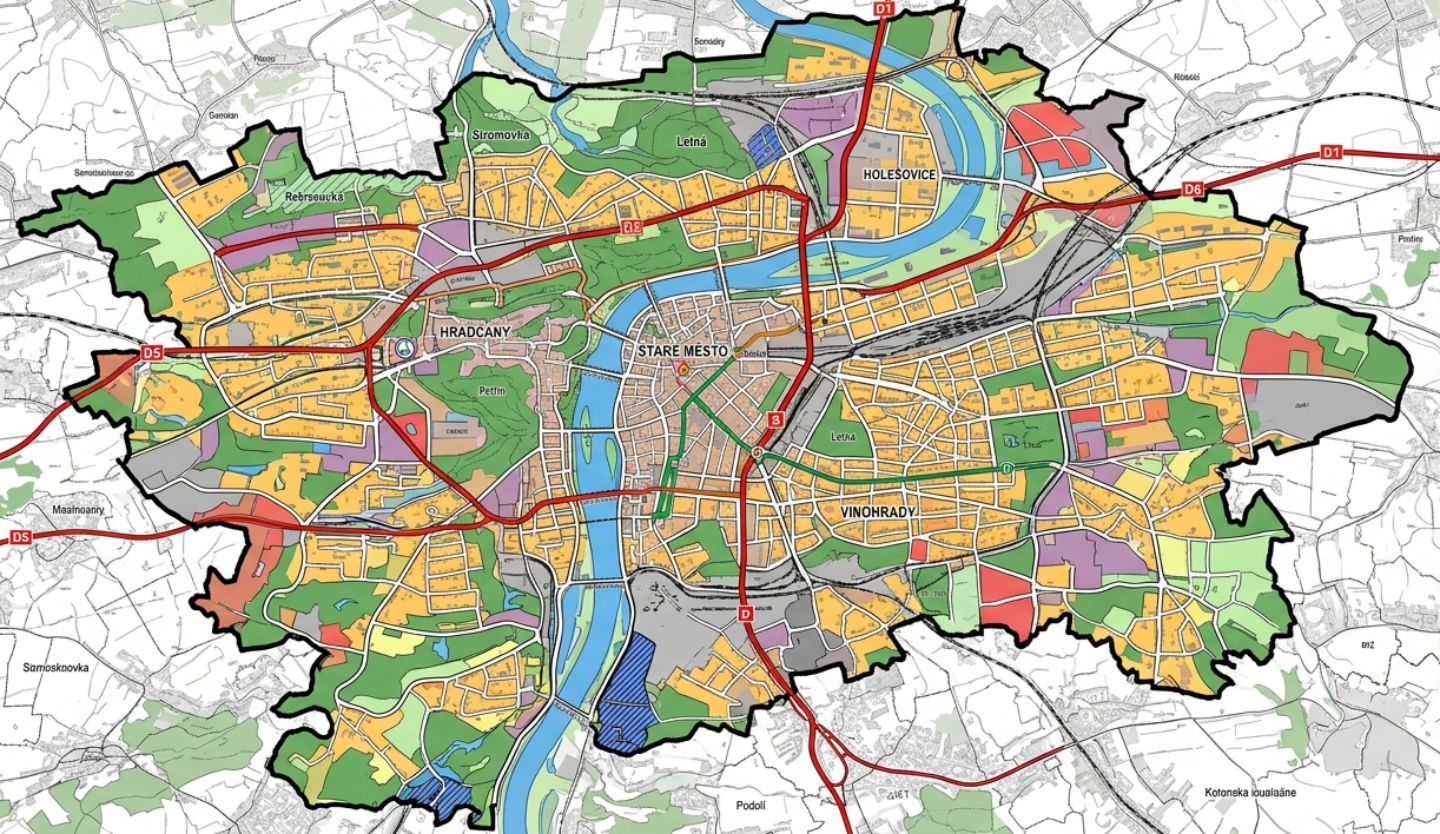
The Ministry of Regional Development (“MMR”) has submitted Draft Amendment No. 2 to the Spatial Development Plan (“ÚRP”), which redefines the so-called acceleration zones for renewable energy sources (“RES”) within the meaning of Act No. 249/2025 Coll., on accelerating the use of certain renewable energy sources (“ZOZE”).[1] Draft Amendment No. 2 to the ÚRP is currently in the preparation phase prior to its public consultation, which is scheduled to take place on 15 May 2026.[2]
Acceleration zones are areas where, from the perspective of the national spatial planning concept, the siting of RES projects is preferred.[3] Their main benefit is a significant acceleration of the permitting processes, based on the fact that key environmental issues are addressed at the very stage of their designation.
How the fast-track permitting regime works
The permitting of RES projects in acceleration zones takes place under a simplified regime in accordance with the RES Act, the core of which is:
The entire mechanism is thus based on the principle that significant environmental impacts are ‘brought forward’ to the level of defining acceleration zones, whilst for specific projects, compliance is primarily verified against conditions pre-determined in the ÚRP.
What is required for the adoption of Amendment No. 2 to the Spatial Development Plan
Draft Amendment No. 2 to the Spatial Development Plan must undergo the standard process for the preparation of spatial planning documentation, a key part of which is the public consultation, during which the public may submit comments, either in writing or electronically, to the Ministry of Regional Development by 1 June 2026 at the latest.
The Ministry of Regional Development must then address these comments and objections and prepare the final version of Draft Amendment No. 2 to the Spatial Development Plan, which will be approved by the Government of the Czech Republic.
It is crucial in this regard that the content of the Spatial Development Plan will be binding for subsequent spatial planning documentation. Following the adoption of Draft Amendment No. 2 to the Spatial Development Plan, it will therefore not be necessary to wait for changes to the local spatial plan at the site of the renewable energy project.
We will keep you informed about the next steps in the implementation of the acceleration zones.
…
…

Banking and financial law, capital markets
Energy law and renewable energy
M&A
Insolvency, restructuring and preventive restructuring
Dispute resolution, arbitration, mediation
Real estate and construction law

Energy law and renewable energy
Corporate and commercial law
Dispute resolution, arbitration, mediation

Energy law and renewable energy
Corporate and commercial law
Dispute resolution and arbitration

Energy law and renewable energy
Insolvency, restructuring and preventive restructuring
EU law

bpv BRAUN PARTNERS has advised IMMOFINANZ on the sale of Brno Business Park office buildings via a share deal to INFOND investment fund. The transaction was closed on March 9, 2018.

Pavel has been working with bpv since 2010, having previously spent several years at a large English law firm.

We would like to congratulate our longtime colleague, Lucie Kalašová, on her promotion to the position of partner. Congratulations!